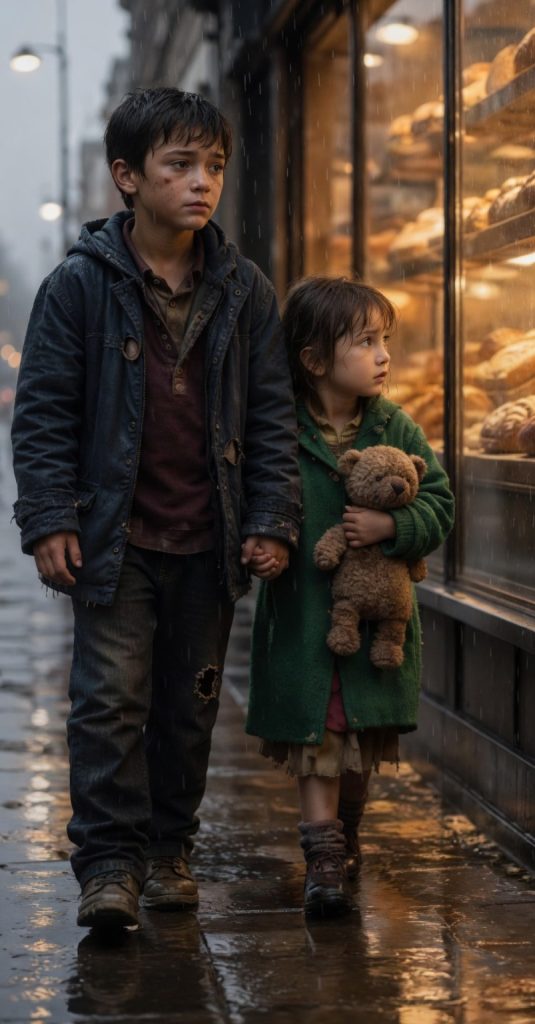
The rain had been falling since early morning, turning the narrow city sidewalk into a mirror of gray clouds, passing cars, and warm yellow lights from shop windows.
Ethan held his little sister’s hand tightly as they walked past the bakery for the third time.
He was only eleven, but he had already learned how to hide fear from someone smaller than him.
His sister, Mia, was five. She wore a green coat that had lost two buttons and carried a small teddy bear against her chest. The teddy bear was wet from the rain, but she held it like it was the only warm thing left in the world.
Inside the bakery window, rows of fresh bread sat under golden lights.
Round loaves.
Soft rolls.
Sweet pastries with sugar shining on top.
The smell drifted through the glass and made Mia slow down.
Ethan felt her hand stop moving.
He did not need to look at her to know what she was staring at.
“Mia,” he said gently, “we should keep walking.”
She did not answer.
Her eyes stayed fixed on the bread behind the glass.
For a moment, she looked like she had forgotten the rain completely.
Then she whispered, “Brother… are we really not eating today?”
Ethan’s throat tightened.
He looked away because he did not want her to see the answer in his face.
They had eaten the last piece of bread the night before. It was hard and small, but Ethan had told Mia he was not hungry so she could have most of it. She believed him because she wanted to.
That morning, they had walked from one street to another, hoping to find the woman who sometimes helped their mother when she was alive. But the address on the old paper led to an empty building with boards on the windows.
After that, Ethan had kept walking.
Not because he knew where to go.
Because stopping felt worse.
“We’ll make it,” he said quietly. “Just stay with me a little longer.”
Mia looked up at him.
Her face was pale from the cold, but her eyes still trusted him.
That was the hardest part.
She still believed he could fix things.
Ethan squeezed her hand and tried to smile.
Then he turned away from the bakery window.
But Mia did not move.
“Can we just look for one more second?” she asked.
Ethan nodded.
One more second was something he could give her.
So they stood there in the rain, two small figures outside a warm bakery, watching other people buy food and walk away with paper bags full of comfort.
Inside, behind the counter, a man with white hair was arranging fresh rolls on a tray.
His name was Mr. Harlan.
Most people in the neighborhood knew him as the quiet baker who opened before sunrise and closed after dark. He did not talk much, but he remembered faces. He remembered who bought the same loaf every morning. He remembered who counted coins carefully. He remembered who looked hungry but never asked for anything.
That was why he noticed the children.
At first, he thought they were waiting for someone.
Then he noticed the boy’s wet shoes.
The little girl’s trembling fingers.
The way they stared at the bread as if looking at something too far away to touch.
Mr. Harlan stopped moving.
There was something painfully familiar about them.
The boy’s posture. The way he stood slightly in front of the little girl. The way he tried to look older than he was.
Mr. Harlan had seen that look before.
Many years ago, in another child’s face.
His own.
The bakery bell rang as a customer left, but Ethan and Mia did not enter. They stayed outside. They did not knock. They did not beg. They only looked.
That made it worse.
Mr. Harlan wiped his hands on his apron and walked toward the front of the shop.
Ethan saw movement behind the glass.
“Come on,” he whispered to Mia. “We should go.”
“But the man is looking at us,” she said.
Ethan glanced toward the bakery.
The baker had stopped near the door.
For one second, their eyes met through the rain-streaked glass.
Ethan froze.
He expected the man to wave them away. Some shopkeepers did that when children stood too long near the window. Ethan had learned not to take it personally. People protected their doors. Their counters. Their warm rooms.
But Mr. Harlan did not wave them away.
Instead, he looked down at something near the display case.
Then he reached for a folded note.
Ethan did not understand.
The baker taped the note inside the window, just above a tray of warm rolls.
The handwriting was large enough to read from outside.
For anyone who needs breakfast: please come in. No questions asked.
Mia leaned closer to the glass.
“What does it say?” she asked.
Ethan read it once.
Then again.
His heart began beating faster.
He did not move.
The bakery door unlocked with a soft click.
Mr. Harlan opened it only halfway and stepped back, giving them space.
“Good morning,” he said gently. “You two look cold.”
Ethan swallowed.
“We don’t have money.”
Mr. Harlan nodded as if he had already expected those words.
“I didn’t ask for money.”
Ethan looked at the note again.
“Why?” he asked.
The baker’s face softened.
“Because someone once fed me when I had nothing,” he said. “And I promised I would not forget.”
Mia looked up at Ethan.
“Can we go inside?”
Ethan hesitated.
He had promised himself he would never take anything unless he could pay for it. But Mia’s hand was freezing. Her lips were trembling. And the smell of warm bread filled the space between them like mercy.
He nodded.
They stepped inside.
The Note Behind the Glass
Warmth touched Mia first.
She closed her eyes for a second as if she had walked into sunlight instead of a bakery.
Mr. Harlan took two towels from behind the counter and handed them to the children.
“For your hair,” he said.
Mia accepted hers with both hands.
“Thank you,” she whispered.
Ethan held the towel but did not use it. His eyes moved around the bakery, searching for a reason to leave quickly if he needed to.
Mr. Harlan noticed but said nothing.
Some children needed food.
Others needed time before they could trust kindness.
He placed two cups of warm milk on the counter, then put a basket of fresh rolls beside them.
Mia stared at the basket.
Ethan touched her shoulder.
“Slowly,” he whispered.
She nodded, but her small hands shook as she picked up a roll.
Mr. Harlan turned away for a moment, pretending to clean the counter so the children would not feel watched.
That was when Ethan noticed a small photograph near the cash register.
It showed a younger Mr. Harlan standing beside a woman in a blue coat. She was smiling, holding a loaf of bread wrapped in paper.
Ethan’s eyes widened.
He knew that face.
It was not exactly the same as he remembered, because the photograph was old and his memories were soft around the edges.
But he knew her.
His mother had the same smile.
The same eyes.
The same way of holding something with care.
Ethan stepped closer.
“Who is that?” he asked.
Mr. Harlan looked at the photograph.
For the first time since they came inside, his expression changed.
“That,” he said quietly, “was the kindest woman I ever met.”
Mia, her mouth full of bread, looked up.
“What was her name?”
“Anna,” Mr. Harlan said.
Ethan stopped breathing for a second.
Anna.
His mother’s name.
He reached into the pocket of his jacket and pulled out the old folded paper they had been carrying all morning. The address on it had led them nowhere, but on the back of the paper were two words his mother had written before she passed away:
Find Harlan.
Ethan had thought Harlan was a street.
Or a building.
Or maybe a person who had moved away long ago.
He slowly placed the paper on the counter.
Mr. Harlan looked down at it.
His hands became still.
“Where did you get this?” he asked.
“My mother left it,” Ethan said. “She told me if things ever got too hard… I should find Harlan.”
Mr. Harlan picked up the paper carefully, as if it might break.
Then he looked at Ethan again.
“What was your mother’s full name?”
“Anna Reed.”
The baker closed his eyes.
Behind him, the ovens hummed softly. Outside, rain tapped against the window.
When Mr. Harlan opened his eyes, they were wet.
“She saved my life,” he said.
Ethan looked confused.
“My mother?”
Mr. Harlan nodded.
“Years ago, before I owned this bakery, I was a young man with nowhere to sleep and nothing to eat. People walked past me every day like I was invisible. But your mother stopped.”
He looked at the photograph.
“She gave me bread. Then she gave me work. She told me that if life ever blessed me, I should leave the door open for someone else.”
Ethan looked at the note in the window.
For anyone who needs breakfast.
No questions asked.
“That was because of her?” he asked.
“Yes,” Mr. Harlan said softly. “Every morning. For twenty years.”
Mia hugged her teddy bear tighter.
“Mommy helped you?”
“She did,” Mr. Harlan said. “More than she ever knew.”
Ethan lowered his head.
“She’s gone now.”
“I know,” Mr. Harlan whispered.
The words surprised Ethan.
Mr. Harlan reached under the counter and took out a small wooden box. He opened it and pulled out a stack of old letters, tied with faded ribbon.
“Your mother wrote to me sometimes,” he said. “Not often. She never asked for anything. She only wanted to know if the bakery was still feeding people.”
He took one letter from the top and handed it to Ethan.
The boy recognized his mother’s handwriting immediately.
Dear Harlan,
If my children ever come to you, please don’t let them feel ashamed. Ethan is proud. Mia is gentle. They may arrive hungry, but what they will need most is kindness. I hope they never need this letter. But if they do, please tell them their mother loved them more than anything in this world.
— Anna
Ethan read the letter in silence.
Then his face crumpled.
He tried to turn away, but Mr. Harlan stepped around the counter and knelt in front of him.
“You carried your sister here,” the baker said. “You kept her safe. Your mother would be proud of you.”
Ethan shook his head.
“I didn’t know where to go.”
“But you came to the right place.”
Mia climbed down from the stool and wrapped her arms around Ethan.
“Brother,” she whispered, “we found him.”
For the first time all day, Ethan let himself cry.
Not loudly.
Not in a way that filled the room.
Just enough for the fear he had been carrying to finally leave his chest.
Mr. Harlan stood and locked the bakery door for a few minutes. He turned the sign to “Back Soon,” then led the children to a small table near the ovens.
There, he placed more bread, soup, and dry clothes from the storage room.
“You can stay here today,” he said. “And tomorrow, we will find the right people to help make sure you are safe.”
Ethan looked up quickly.
“You’re not sending us away?”
“No,” Mr. Harlan said. “I am keeping a promise.”
Outside, the rain continued.
People walked past the bakery window and saw the note still taped to the glass.
For anyone who needs breakfast: please come in. No questions asked.
But inside, something had changed.
The note had not only fed two hungry children.
It had delivered them to the one person their mother trusted.
Years later, Ethan would remember that morning as the day the world did not become easy, but it became possible again.
He would remember the smell of warm bread.
The sound of the lock clicking open.
The way his sister smiled with crumbs on her coat.
And the old baker who looked at two children in the rain and did not see strangers.
He saw a promise returning home.
Final Note
This is a fictional AI-created story made for entertainment purposes. The characters, names, places, and events are imaginary. Any resemblance to real people, real places, or real events is purely coincidental.