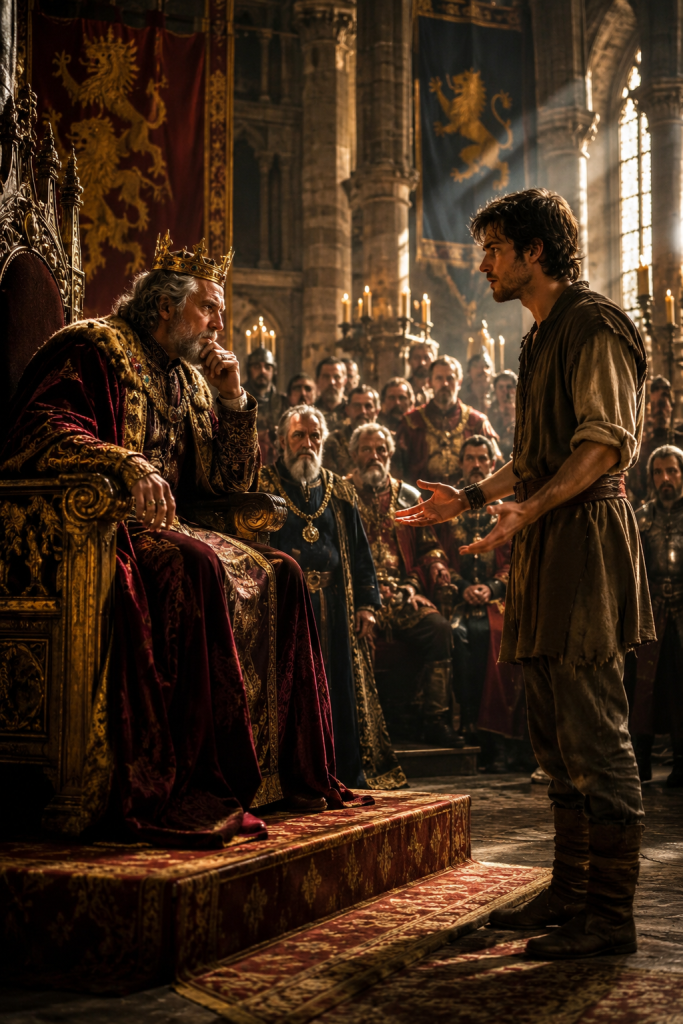
The throne room of Eldoria had not been silent in years.
There was always some sound inside those ancient stone walls — the low voices of councilmen, the footsteps of guards, the crackle of candles, the turning of scrolls, the soft whisper of silk robes as nobles moved through the hall.
But when the young man stepped onto the red carpet and walked toward the throne, every voice disappeared.
He did not look like a noble.
His boots were worn from travel. His tunic was patched at the shoulder. His hair was damp from the morning fog, and his hands were rough like someone who had known work far more than comfort.
Yet he walked with a strange courage.
Not arrogance.
Not pride.
Courage.
At the far end of the hall, King Alaric sat on the golden throne of Eldoria, his crown heavy above tired eyes. He was old now, though no one dared say it openly. His beard had turned silver, and his face carried the weight of a man who had ruled through grief for too many years.
Behind him hung the banners of the kingdom — crimson and blue, stitched with golden lions.
Around him stood the royal court: ministers, knights, scribes, and noble families who had spent their lives studying the king’s moods.
They knew when he was angry.
They knew when he was bored.
But none of them knew what to make of the expression on his face when the young stranger stopped before him and bowed.
“Speak,” said the king.
The young man lifted his head.
“My name is Elias,” he said. “I come from the village of Northmere.”
A murmur moved through the court.
Northmere was a poor place, far beyond the capital, known for sheep farms, cold winters, and people who rarely entered royal halls.
The king looked unimpressed.
“Many men come from villages,” he said. “Few are brought into my throne room. Why are you here?”
Elias swallowed.
His fingers tightened around something hidden in his palm.
“I carry a message,” he said.
“From whom?”
Elias looked up at the king.
“From the queen.”
The silence that followed was not ordinary silence.
It was the silence of a wound being touched.
Queen Seraphina had vanished twenty-two years earlier.
Some said she had been taken by illness and buried in secret. Others whispered she had fled the palace after the death of her infant son. A few believed she had been betrayed by people inside the castle.
But no one spoke of those things in front of King Alaric.
Not if they valued their place in the kingdom.
The king’s hand tightened on the arm of his throne.
“The queen is gone,” he said, his voice colder now.
Elias did not lower his eyes.
“No, Your Majesty,” he said softly. “She lived.”
Gasps spread through the hall.
Lord Veyron, the king’s chief adviser, stepped forward at once. He was tall, thin, and dressed in dark velvet, with a face that never revealed more than he wanted it to.
“This is an insult,” Lord Veyron said. “A village boy repeating tavern lies in the royal court.”
Elias turned toward him.
“I was told you would say that.”
The adviser’s expression flickered.
Only for a moment.
But the king noticed.
Alaric leaned forward.
“Who told you?”
Elias slowly opened his hand.
In his palm lay an old golden seal.
It was small, round, and scratched by time. In the center was the mark of the royal house — the twin lions of Eldoria surrounding a single star.
But beneath the star was something no ordinary person would know.
A tiny engraved rose.
The private mark of Queen Seraphina.
The king rose from his throne.
The hall froze.
He took one step down from the platform, then another, staring at the seal as if the years had fallen away from him.
“Where did you get that?” he asked.
Elias’s voice trembled, but he answered clearly.
“She gave it to me before she died.”
The king’s face changed.
Before that moment, he had looked like a ruler.
Now he looked like a husband.
“Seraphina,” he whispered.
The name moved through the hall like candlelight.
Elias held the seal out.
“She said you would know it. She said if I ever reached this hall, I should show you before speaking another word.”
King Alaric descended the last step from the throne and took the seal carefully.
His hands were shaking.
He turned it over.
On the back were words engraved so small that only someone holding it close could read them.
For the child who must live.
The king closed his eyes.
For twenty-two years, he had believed his wife and newborn son were gone. The royal records said the queen died during her journey to the western chapel. The infant prince, weak from birth, was said to have been buried with her.
Alaric had never seen the bodies.
He had been told it was better not to.
He had been told the grief would be easier if he remembered them as they were.
He had believed those who stood closest to him.
And now a stranger from Northmere stood before him holding a seal that had vanished the same night his world ended.
“What was her message?” the king asked.
Elias reached inside his tunic and pulled out a folded letter, wrapped in faded blue cloth.
“This,” he said. “She told me only the king may open it.”
Lord Veyron stepped forward sharply.
“Your Majesty, this is dangerous. It may be forged. It may be a trap.”
The king did not look at him.
“Silence.”
The word was quiet, but it struck the room like a bell.
Lord Veyron stepped back.
Elias handed the letter to the king.
Alaric opened it slowly.
The handwriting was older, weaker, but unmistakable.
His wife’s hand.
My beloved Alaric,
If this letter reaches you, then the boy has survived long enough to return to the place where he was born. His name is Elias now, but that was not the name we gave him.
The king stopped reading.
His breath caught.
The court watched him, unable to move.
He forced himself to continue.
The night I disappeared, I did not leave you. I fled because I learned that our son was in danger from men who feared what he would one day inherit. I was told you had ordered him removed from the line of succession. I know now that was a lie, but by the time I understood, I could no longer safely return.
I raised him far from the palace, not as a prince, but as a good man. I taught him kindness before power, patience before pride, and truth before comfort.
If he stands before you now, do not judge him by his clothes. Judge him by his heart.
He is your son.
And he has come home.
The king lowered the letter.
For a long moment, no one breathed.
Elias stood still, his face pale.
He had known there was a secret.
He had known the woman who raised him was not an ordinary village widow.
But she had never told him everything.
Not until the end.
Not until she was too weak to travel and placed the letter in his hands.
“Go to Eldoria,” she had whispered. “Stand before the king. Do not ask for a crown. Ask for the truth.”
Elias had thought perhaps he was a servant’s child.
Perhaps the son of a guard.
Perhaps someone connected to the palace by shame or kindness.
He had not imagined this.
The king looked at him with eyes full of disbelief and grief.
“What name did she give you at birth?” Alaric asked, barely able to speak.
Elias reached into the blue cloth and removed a second object.
A small silver bracelet, meant for an infant, preserved carefully for more than two decades.
Inside it were engraved three words.
Prince Adrian Alaric.
The king’s knees almost failed him.
A guard moved to help, but Alaric raised a hand and remained standing.
“My son,” he whispered.
The words broke the room open.
Some nobles bowed their heads.
Others exchanged nervous looks.
Lord Veyron’s face had gone completely still.
The king turned slowly toward him.
“You told me they were dead.”
Lord Veyron straightened.
“Your Majesty, I only repeated what the messengers confirmed.”
Elias looked at him.
“My mother said the false message came from inside the palace.”
The court stirred.
The king’s voice became low.
“Who sent it?”
Elias reached into the cloth one last time.
There was another page.
Not a letter from the queen.
A copied record.
A payment order.
The seal at the bottom belonged to the royal council.
And the signature belonged to Lord Veyron.
The Truth Behind the Lost Prince
Lord Veyron’s face did not change at first.
That was what frightened the court most.
A guilty man might shout.
An innocent man might protest.
But Veyron simply looked at the paper as though deciding which lie would fit best.
“This proves nothing,” he said.
The king turned the record toward the court.
“It proves a payment was sent to the western guard on the same night my wife vanished.”
Veyron bowed his head slightly.
“Many payments are sent under council authority.”
Elias stepped forward.
“My mother said one guard helped her escape after realizing the order was false. He kept a copy of the payment record to protect her. Before he died, he gave it back to her.”
The king looked at Elias.
“What order?”
Elias met his father’s eyes.
“To take the infant prince away from the queen and claim he had died of sickness.”
A wave of shock moved through the nobles.
Several councilmen stepped away from Veyron.
The adviser’s calm finally cracked.
“This is madness,” he said. “A village stranger appears with old papers, and the court believes him because he has a pretty seal?”
The king lifted the royal seal in his hand.
“This is not a pretty seal,” he said. “This was made for my wife by my own hand.”
The hall fell silent again.
Alaric turned to the captain of the guard.
“Search the old council archives. Bring every record from the night the queen disappeared.”
The captain bowed.
“At once, Your Majesty.”
Veyron’s mouth tightened.
“After all these years, what good will old records do?”
The king looked at him.
“Truth does not rot with age.”
The words echoed under the stone arches.
Elias felt his heart pounding.
He had not come to overthrow anyone.
He had not come with an army.
He had come with an old letter, a seal, and the memory of a woman who raised him in a cottage far from royal life.
Now the entire kingdom seemed to be shifting beneath his feet.
A servant brought a chair, but Elias did not sit.
The king noticed.
“You are tired,” Alaric said.
“I have been walking for twelve days,” Elias replied.
“Then sit.”
Elias hesitated.
The only chair nearby was made for nobles.
He looked at his worn sleeves.
The king understood.
“You are not a guest in this hall,” Alaric said softly. “You are blood of this house.”
Elias sat slowly.
That simple act made several nobles lower their eyes.
A prince in peasant clothes.
A king who had lost a son and found a man.
And a kingdom watching its own history change in front of them.
The captain of the guard returned before sunset with three old record books and a locked iron box.
Inside the box were sealed council orders from the year of the queen’s disappearance. Most were ordinary. Trade requests. Guard rotations. Tax records.
But one document had been hidden under a false label.
It was not signed by the king.
It was signed by Lord Veyron.
The order did not mention death. It mentioned relocation. Separation. Silence.
The infant prince was to be removed “for the stability of the realm.”
The queen was to be told the king approved.
The king was to be told the queen and child were gone.
No one spoke when the document was read aloud.
Not even Veyron.
The king turned to his old adviser with grief in his eyes.
“Why?”
Veyron’s mask finally fell.
“Because love makes kings weak,” he said. “You would have given the realm to a child raised by a queen who trusted farmers more than nobles. I protected the throne.”
Alaric stared at him.
“No,” the king said. “You protected your influence.”
Veyron looked around the hall, searching for support.
He found none.
The king did not call for harshness.
He did not roar.
He did not order a dramatic punishment before the court.
Instead, he spoke with a sadness more powerful than anger.
“Remove him from the council. Confine him under guard until a lawful hearing can be held. Let the kingdom see records, witnesses, and truth. We will not answer betrayal with chaos.”
The guards stepped forward.
Veyron did not resist.
As he was led away, his eyes passed over Elias.
“You do not know how to rule,” he said.
Elias looked at him calmly.
“No,” he replied. “But I know what it means to be lied to.”
For the first time that day, the king almost smiled.
When the hall emptied, only Elias and Alaric remained near the throne.
The candles burned low.
Outside the tall windows, evening light turned the stone walls gold.
The king held the queen’s letter again.
“What was she like?” he asked.
Elias looked down.
“To the village, she was called Mara,” he said. “She healed children, settled arguments, and always gave her bread to others first. She never wore jewels. She never asked anyone to bow.”
Alaric closed his eyes.
“That was Seraphina.”
“She spoke of you,” Elias said.
The king looked up quickly.
“What did she say?”
Elias thought for a moment.
“She said you laughed before the crown became too heavy.”
The king’s face trembled.
Elias continued, “She said you loved music badly played, hated cold soup, and once climbed a chapel tower to bring her a flower from the roof.”
For the first time in twenty-two years, King Alaric laughed through tears.
A quiet, broken laugh.
The sound of a man remembering himself.
Then he looked at Elias.
“I do not know how to be your father after losing you for a lifetime.”
Elias looked toward the golden throne.
“And I do not know how to be a prince.”
The king nodded slowly.
“Then we will learn carefully.”
Elias held the infant bracelet in his hand.
“I do not want people to kneel to me because of a name.”
“Good,” said Alaric. “Then perhaps you are already better prepared than most.”
The next morning, the king did something no ruler of Eldoria had ever done.
He opened the throne room doors to common people.
Farmers.
Bakers.
Stonecutters.
Mothers with children.
Travelers from the far villages.
He stood before them with Elias at his side and told the truth.
Not the polished version.
Not the comfortable one.
The truth.
That the queen had not abandoned the kingdom.
That the prince had not died.
That lies had lived in the palace longer than justice.
And that from that day forward, the court would no longer be a place where truth disappeared behind velvet curtains.
Elias did not wear a crown that morning.
Only the simple clothes he had arrived in.
But when the people saw the golden seal in his hand and the king’s tears beside him, many understood something before the nobles did.
The lost prince had not returned as a conqueror.
He had returned as proof that a kingdom can lose its way and still find the road back.
Months later, a portrait was placed in the royal hall.
It showed Queen Seraphina not in jewels, but in a simple blue dress, holding a child beneath a tree in Northmere. Beside it hung a smaller frame containing her letter.
Visitors often stopped to read the final line:
Judge him by his heart.
And every time Elias passed it, he remembered the woman who raised him not to seek power, but to carry truth.
Years later, when King Alaric grew too weak to sit long in the throne room, Elias would sit beside him and listen to stories of the mother he had known and the queen the kingdom had lost.
And when the day finally came for the crown to pass, Elias did not begin his reign with a feast.
He began it by opening the palace gates.
Because he understood something the old court had forgotten:
A throne is not made powerful by gold.
It is made worthy by the people who are finally allowed to stand before it and speak the truth.
Final Note
This is a fictional AI-created story made for entertainment purposes. The kingdom, characters, names, places, and events in this story are imaginary. Any resemblance to real people, real historical figures, real kingdoms, or real events is purely coincidental.