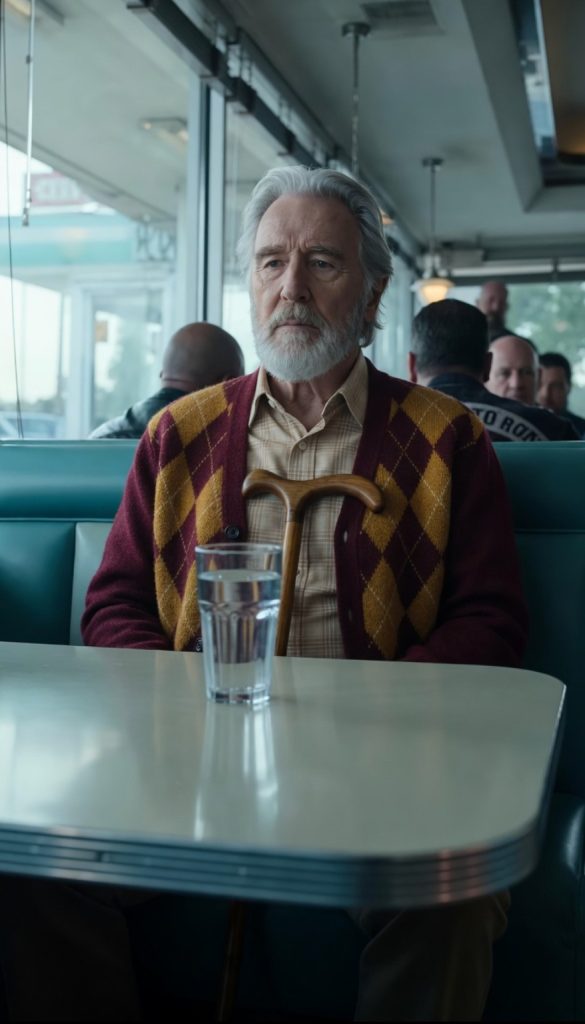
The diner was almost full that morning, but the old man sat alone.
He had chosen the corner booth by the window, the same booth he had chosen every Thursday for the last eight years. In front of him was a glass of water, untouched. Beside him rested a polished wooden cane with a curved handle, worn smooth from years of use.
His name was Thomas Hale.
Most people in the diner did not know that.
To them, he was only the quiet old man with silver hair, a heavy cardigan, tired eyes, and a habit of looking out the window as if he were waiting for someone who never came.
The waitress knew him as polite.
The cook knew him as patient.
The younger customers barely noticed him at all.
Thomas preferred it that way.
He had lived long enough to understand that sometimes being invisible was peaceful.
But that morning, peace did not last.
A group of loud men entered the diner just after ten. They wore heavy jackets, thick boots, and the kind of confidence that made people lower their voices without knowing why. They took the booth behind Thomas and filled the room with laughter, chair scraping, and rough jokes.
One of them, a tall man named Vince, kept glancing toward the old man.
At first, Thomas ignored him.
He had seen men like Vince before. Men who mistook noise for strength and cruelty for courage. Men who needed a room to look at them before they could feel important.
Thomas lifted his glass of water but did not drink.
Behind him, the laughter grew louder.
“Look at that,” Vince said to his friends. “Grandpa brought a cane to breakfast.”
The others laughed.
Thomas looked out the window.
Outside, the street was gray with morning rain. Cars passed slowly. A woman crossed the road holding a newspaper over her head. Life continued, unaware of the small storm forming inside the diner.
The waitress, Maria, noticed the tension. She approached Thomas’s table and asked softly, “Everything okay, Mr. Hale?”
Thomas nodded once.
“Yes, thank you.”
But Vince had heard her.
“Mr. Hale?” he repeated loudly. “Sounds important.”
Thomas said nothing.
That seemed to bother Vince more than any insult could have.
He stood up.
The diner became quieter.
Maria stopped near the counter.
Vince walked from the right side of the booth, slow and theatrical, as if he wanted everyone to watch. His friends grinned behind him. The other customers turned their faces toward the scene but stayed in their seats.
Thomas kept both hands folded in front of him.
Vince looked down at the cane.
“You mind if I borrow this?” he asked.
Thomas did not reach for it.
He simply looked up.
“It helps me walk,” he said calmly.
Vince smiled.
“Then I’ll be quick.”
Before Maria could speak, Vince grabbed the cane from beside the booth.
The room tightened.
Thomas did not move.
Vince lifted the cane, looked around at his friends, then swung it down hard toward the table.
The wooden handle struck the glass.
Water burst across the tabletop.
The glass shattered, pieces scattering across the floor with a sharp sound that made several customers gasp.
Vince’s friends burst into laughter.
One of them clapped.
Another said, “Careful, old man. Your breakfast is leaking.”
Thomas looked down at the broken glass.
Then he looked at his cane in Vince’s hand.
There was no fear in his face.
No panic.
No anger.
Only a strange sadness, as if he had expected better from the world and was disappointed to be proven wrong again.
Maria hurried forward.
“Vince, that’s enough,” she said.
But Vince was still laughing.
“What?” he said. “It was just a glass.”
Thomas slowly reached into his cardigan pocket.
His movement was so calm that the laughter began to fade before anyone understood why.
He took out an old phone.
Vince watched him, amused.
“You calling someone?” he asked. “Your nurse?”
Thomas raised the phone to his ear.
His eyes did not leave Vince.
When the call connected, Thomas spoke only five words.
“It’s Thomas. Come now.”
Then he ended the call.
The diner went quiet.
Not because the words were loud.
Because they were too calm.
Vince held the cane loosely now, his smile still on his face but less certain than before.
“That supposed to scare me?” he asked.
Thomas did not answer.
He only looked toward the window.
For the first time, Vince followed his gaze.
Nothing happened at first.
The rain continued.
A car passed.
Someone in the kitchen dropped a pan, and the sound made everyone flinch.
Then, from down the street, came the low sound of engines.
One black car turned the corner.
Then another.
Then two more.
They were not speeding wildly. They were not chaotic. They were quiet, polished, and serious. They pulled up outside the diner one after another and stopped in a perfect line near the curb.
The laughter disappeared completely.
Vince’s friends sat up straighter.
Maria stared through the window.
The diner door opened.
Three men stepped inside first. They wore dark suits, clean coats, and calm expressions. Behind them came a woman in her forties with a leather folder in her hand. She looked around the diner once, saw Thomas, and walked directly toward him.
“Mr. Hale,” she said softly. “Are you all right?”
Thomas nodded.
“I am.”
Her eyes moved to the broken glass on the floor, then to Vince holding the cane.
Vince suddenly realized he was still holding it.
He lowered it slowly.
The woman looked at him.
“Please return Mr. Hale’s cane.”
Vince tried to laugh, but nothing came out.
“Listen,” he said, “it was just a joke.”
Thomas finally stood.
Slowly.
Not dramatically.
Just carefully, like a man whose body had grown tired but whose spirit had not.
One of the suited men moved as if to help him, but Thomas raised a hand.
“I can stand.”
Vince handed the cane back.
Thomas took it, placed the wooden tip gently on the floor, and looked at the younger man.
“You broke the glass,” Thomas said quietly. “But that is not what matters.”
Vince swallowed.
“What matters,” Thomas continued, “is that you wanted everyone in this room to see you make someone feel small.”
No one spoke.
The older woman with the folder placed a hand on the back of Thomas’s booth.
“Sir,” she said, “we can leave now if you want.”
Thomas shook his head.
“No. Not yet.”
He turned toward Maria.
“I’m sorry about the glass.”
Maria shook her head quickly.
“You don’t have to apologize.”
“I do,” Thomas said. “This is still my favorite diner.”
Vince’s eyes narrowed.
“Your favorite diner?”
The woman with the folder looked at him.
“Mr. Hale owns the building.”
The words landed heavily.
The diner seemed to shrink around Vince.
Thomas did not smile. He did not enjoy the humiliation. That was what made the moment worse for the younger man.
The old man had power.
But he was not using it to crush him.
He was simply showing him the truth.
The Man Everyone Had Forgotten
Vince looked from Thomas to the people in suits, then back to the black cars outside.
“You own this place?” he asked.
Thomas rested both hands on his cane.
“I own the building,” he said. “Maria owns the heart of the place.”
Maria looked down, emotional.
Thomas continued, “Years ago, this diner almost closed. The owner was sick. The rent was impossible. I bought the building so it could stay open. I asked only one thing.”
“What?” Vince asked.
“That anyone hungry could get a meal here, even if they could not pay.”
The room shifted.
Several customers looked toward the counter, where a small sign sat beside the cash register. Many had seen it before but never really thought about it.
Need a meal? Ask quietly. No shame here.
Vince looked at the sign, then back at Thomas.
Something in his face changed slightly.
Thomas noticed.
“You’ve seen that sign before,” the old man said.
Vince’s jaw tightened.
“No.”
Thomas studied him.
“Yes, you have.”
The silence grew deeper.
One of Vince’s friends muttered, “Come on, man, let’s go.”
But Vince did not move.
Thomas stepped closer, his cane steady against the floor.
“What is your name?” he asked.
Vince looked away.
“Vince.”
“Vince what?”
“Vince Miller.”
The woman with the folder glanced at Thomas.
Thomas’s expression changed, only slightly.
“Miller,” he repeated.
Vince looked uncomfortable now.
“What?”
Thomas looked toward Maria.
“Do you remember a woman named Grace Miller?”
Maria’s eyes widened.
“Yes,” she whispered. “She used to come here with a little boy. Years ago.”
Vince froze.
Thomas looked back at him.
“Your mother?”
Vince’s face lost color.
The diner was silent enough now that everyone heard his breathing change.
“How do you know my mother?” he asked.
Thomas’s voice softened.
“She came here when she had nowhere else to go. You were about seven. Maybe eight. You sat in that booth near the door and ate pancakes like you hadn’t eaten in days.”
Vince stared at him.
The arrogance was gone.
In its place was confusion.
And something much more painful.
Memory.
Thomas continued gently, “Your mother cried at the counter because she could not pay. Maria told her the meal was already covered.”
Vince looked toward Maria.
Maria nodded, tears shining in her eyes.
“She was kind,” Maria said. “Always apologizing. Always trying to protect you.”
Vince lowered his head.
His friends looked at him differently now. Not mocking. Not laughing. Just quiet.
Thomas reached into his pocket and pulled out a small folded note.
The woman with the folder looked surprised, as if she had forgotten he carried it.
Thomas unfolded it carefully.
“I keep some letters,” he said. “Not because people owe me anything. Because they remind me why kindness matters.”
He handed the note to Vince.
Vince did not want to take it at first.
Then he did.
The paper was old and soft at the edges.
The handwriting was his mother’s.
Dear Mr. Hale,
You don’t know what you did for my son today. He laughed for the first time in weeks. I hope one day he grows into a man who remembers that someone helped him when he had nothing.
Thank you for letting us eat with dignity.
— Grace Miller
Vince read the note once.
Then again.
His hands began to shake.
The old man said nothing.
The diner said nothing.
Vince looked at the broken glass on the floor, then at the cane in Thomas’s hand.
For the first time that morning, he seemed to understand what he had done.
Not to a weak old man.
To someone who had once helped save the boy he used to be.
“My mother wrote this?” he asked.
Thomas nodded.
“She was proud of you.”
Vince’s eyes filled suddenly.
He turned away, embarrassed, but there was nowhere to hide. Not from the room. Not from the past. Not from himself.
“She died five years ago,” he said quietly.
“I’m sorry,” Thomas replied.
Vince let out a shaky breath.
“She used to tell me about a man who helped us once. I thought it was just something she said.”
“It was true.”
Vince looked at the note again.
His voice broke.
“I didn’t know it was you.”
Thomas looked at him with sadness but no hatred.
“We rarely know who we are hurting until we stop long enough to see them.”
Vince wiped his face quickly with the back of his hand.
Then he looked toward Maria.
“I’ll pay for the glass.”
Maria nodded softly.
But Thomas shook his head.
“No.”
Vince looked confused.
“You won’t let me?”
“I want you to do something better.”
“What?”
Thomas pointed to the sign by the register.
“Come back tomorrow morning. Not with your friends. Alone. Help serve breakfast to anyone who needs it.”
Vince stared at him.
“That’s it?”
Thomas’s voice remained calm.
“No. Do it for thirty days.”
One of Vince’s friends almost laughed, but stopped when Vince turned and looked at him.
Then Vince looked back at Thomas.
“Why would you offer me that after what I did?”
Thomas leaned gently on his cane.
“Because punishment teaches fear. Responsibility can teach a man who he might still become.”
Vince looked at the note in his hand.
His mother’s words seemed heavier than any threat.
Finally, he nodded.
“Thirty days.”
Thomas gave him the smallest nod.
“Good.”
The people in suits relaxed slightly. The cars outside stayed waiting, quiet and powerful under the gray morning sky.
But the real power in the room was no longer in the cars.
It was in the broken glass no one touched yet.
In the letter from a mother.
In the old man who could have crushed Vince with money, reputation, and authority — but chose instead to give him a chance to become better.
The next morning, Vince returned.
He came alone.
No leather jacket.
No loud laughter.
No audience.
Just a man standing outside the diner door before opening time, holding a new glass wrapped in paper and a bouquet of simple white flowers.
Maria unlocked the door.
Thomas was already sitting in his usual booth.
Vince walked in slowly and placed the flowers on the table.
“For my mother,” he said.
Thomas looked at them.
Then at Vince.
“She would have liked that.”
Vince swallowed.
“I’m sorry,” he said.
Thomas looked at him for a long moment.
Then he pointed toward the counter.
“Apron is over there.”
For thirty days, Vince served breakfast.
At first, people stared at him.
Some recognized him from that morning. Some avoided his eyes. Some whispered.
But he kept coming.
He poured coffee.
Carried plates.
Cleaned tables.
And every morning, when someone came in hungry and ashamed, Vince was the first to point quietly to the sign.
Need a meal? Ask quietly. No shame here.
By the end of the month, he understood why his mother had written that letter.
Not because the food had been free.
Because the kindness had allowed her to keep her dignity.
On the thirtieth day, Thomas called him to the booth.
“You can stop now,” the old man said.
Vince looked around the diner.
Maria was laughing near the counter. A young mother was feeding her child pancakes at the far booth. Outside, the city was waking up slowly under a pale morning sky.
Vince sat down across from Thomas.
“I don’t think I want to stop.”
Thomas smiled faintly for the first time.
“Then don’t.”
Vince looked at the cane leaning beside the booth.
The same cane he had used to break the glass.
The same cane that had started everything.
“I thought power meant making people afraid of you,” Vince said.
Thomas looked out the window.
“So did I once.”
“What changed?”
Thomas turned back to him.
“Life. Loss. And people kind enough to forgive me when I didn’t deserve it.”
Vince folded his mother’s note carefully and placed it back on the table.
“Can I keep a copy?”
Thomas nodded.
“The original belongs to you.”
Vince looked at him, surprised.
Thomas pushed the letter gently across the table.
“Your mother wrote it for both of us,” he said.
Vince held the note in both hands.
For a moment, he looked very young.
Not weak.
Just human.
And Thomas, the old man everyone had underestimated, lifted his glass of water — a new one now — and finally took a drink.
Outside, the black cars were gone.
The street was ordinary again.
But inside the diner, something had changed.
A man who came in to humiliate someone left with his mother’s memory in his hands.
And an old man who could have answered cruelty with power chose instead to answer it with a lesson no one in that diner would ever forget.
Final Note
This is a fictional AI-created story made for entertainment purposes. The characters, names, places, businesses, and events in this story are imaginary. Any resemblance to real people, real organizations, real businesses, or real events is purely coincidental.