Rain had been falling since dawn, soft at first, then steady enough to turn the city streets into dark mirrors.
People hurried past the expensive bakery on Mercer Street without looking down. Their coats were buttoned, their coffee cups warm, their days already planned.
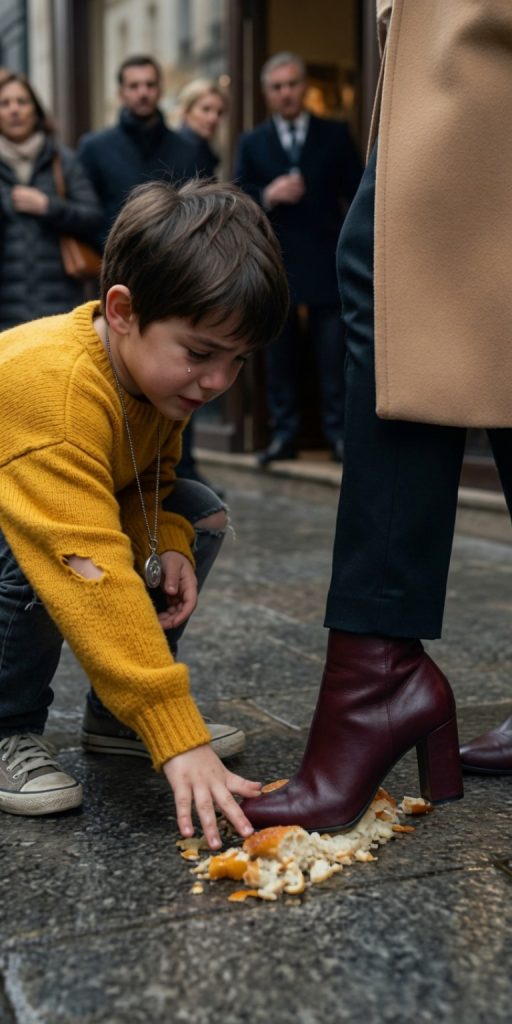
At the edge of the bakery entrance, a young boy knelt on the wet pavement.
His name was Daniel.
He could not have been older than ten.
His sweater was torn at the elbow, his jeans were damp at the knees, and his shoes were so worn that the rain had already reached his socks. A small silver pendant hung around his neck, resting against his chest, old and dull from years of use.
In front of him, on the cold ground, lay a crushed piece of bread.
One elegant red boot stood over it.
The woman wearing it did not move.
Daniel’s hand hovered just above the wet bread as if he still hoped he might save some part of it. A tear slid down his cheek, but he wiped nothing away. He had learned that hunger gave a person very little time to care about pride.
From the bakery doorway, several people watched in uncomfortable silence.
Some looked shocked.
Some looked away.
No one stepped forward.
The woman in the camel coat stood tall and impatient, her face sharp with irritation, as if the boy’s presence had ruined the perfection of her morning.
“I told you not to touch it,” she said coldly. “You nearly ran into me.”
Daniel lowered his eyes.
“I’m sorry,” he whispered. “It was for my sister.”
The woman’s expression did not soften.
“If your parents taught you any manners, they would have taught you not to beg in front of shops like this.”
Daniel said nothing.
Not because he agreed.
Because he had no strength left to defend himself.
His little sister, Lucy, was waiting beneath the bus stop shelter half a block away. She was six years old, weak from fever, and wrapped in the only dry scarf Daniel could find that morning. He had left her there for just a minute when he saw a man leaving the bakery with a paper bag. One warm roll had slipped onto the pavement. Daniel ran toward it before it could get soaked.
He was almost fast enough.
Almost.
Then the woman stepped forward without looking, and the bread disappeared under her heel.
Now the last chance Daniel had seen all morning was broken into the rain-dark sidewalk.
He reached down carefully, still hoping a piece might be clean enough to take to Lucy.
That was when a voice came from the bakery door.
“Wait.”
It was not loud.
But it carried the kind of quiet authority that made everyone turn.
An older man stood at the entrance with one hand on the glass door. His hair was silver, his coat dark and tailored, and his eyes fixed not on the woman—but on the pendant around the boy’s neck.
He took a slow step forward.
“Where did you get that necklace?” he asked.
Daniel looked up, startled.
For a moment, even the woman in the red boots fell silent.
The old man came closer, rain touching the shoulders of his coat. He was not looking at the bread anymore. He was looking only at the pendant, as if he had seen a ghost hanging from the boy’s neck.
Daniel instinctively covered it with his hand.
“It was my mother’s,” he said softly.
The man’s face changed.
Not with anger.
With shock.
“Your mother’s name,” he said, voice suddenly unsteady. “What is your mother’s name?”
Daniel hesitated. Strange men did not usually ask such questions. But something in the old man’s expression made him answer.
“Anna,” he said. “Anna Hale.”
The old man stopped breathing for one second.
Behind him, the woman in the camel coat frowned in confusion.
The older man swallowed hard, then looked toward the shelter down the street, where Lucy’s tiny figure was barely visible through the rain.
“Your sister is waiting there?” he asked.
Daniel nodded.
The old man looked back at him, and when he spoke again, his voice had changed completely.
“Bring her inside.”
The woman stared at him.
“Mr. Whitmore,” she said sharply, “you can’t be serious—”
He turned toward her, not angry, but firm enough to silence her immediately.
“I am very serious.”
Then he looked back at Daniel.
“Bring your sister inside,” he repeated. “Now.”
Daniel stood slowly. He did not trust kindness easily, not after the last year, not after all the doors that had closed in his face. But the rain was getting heavier, and Lucy had been coughing all morning.
So he turned and ran to the bus stop.
When he returned, Lucy was leaning against him, pale and shivering. The old man opened the bakery door wide, and warm air rushed out around them, carrying the smell of bread, cinnamon, and coffee.
For the first time that day, Lucy lifted her head and smiled faintly.
Inside, the bakery was bright and golden. A young server quickly brought towels and a chair near the heater. Daniel stayed standing, one protective arm around his sister, ready to leave if anyone changed their mind.
The older man removed his gloves and studied them with eyes that seemed to remember more than they wanted to say.
“My name is Edward Whitmore,” he said. “This bakery belongs to my family.”
Daniel glanced toward the woman outside, who had not yet left. She stood under the awning, watching through the glass with visible annoyance.
Edward followed his gaze.
“You don’t need to worry about her,” he said quietly.
Then he looked at the pendant again.
“May I see it?”
Daniel hesitated, then carefully lifted the chain over his head and placed it in the old man’s open palm.
It was a silver oval, worn smooth around the edges. On its face was a small engraved lily.
Edward closed his fingers around it as if afraid it might vanish.
“I gave this to my daughter twenty years ago,” he said.
Daniel blinked.
“My mother?”
Edward nodded slowly.
The room became still.
“I have not seen her since she left home.”
Lucy looked between them, confused.
“You know our mommy?” she asked.
Edward’s eyes filled before he could stop them.
“Yes,” he said. “I knew her before I forgot how to be the father she needed.”
Daniel stared at him.
He had spent the last year moving from one temporary room to another with Lucy and their mother. Then Anna got sick. Too sick to work. Too weak to keep running from unpaid rent and promises that never came true. Two months before she died, she gave Daniel the pendant and said only one thing:
“If life becomes too hard, go to Mercer Street. If the right person sees this, he will know.”
Daniel had not understood her then.
Now, standing in a warm bakery in borrowed dryness, he suddenly did.
“You’re my grandfather?” he asked.
The question broke something in Edward’s face.
“I don’t deserve that word yet,” he said quietly. “But yes… I am your mother’s father.”
The Promise Anna Left Behind
Edward led the children to a private room behind the bakery kitchen, away from the crowd and the curious stares. A small fire burned in the corner, and the table was quickly filled with hot soup, fresh bread, and tea for Lucy.
Daniel watched his sister eat like someone waking from a dream.
Only when she had color back in her cheeks did he begin to believe this was real.
Edward sat across from them, the pendant still in his hand.
“I thought Anna hated me,” he said after a long silence.
Daniel looked down.
“She didn’t hate you,” he said. “She just never talked about you much.”
Edward gave a painful smile.
“That may be worse.”
He leaned back and stared at the pendant.
“Your mother grew up with every comfort money could buy, but almost no freedom. I wanted her life planned, polished, controlled. I thought I was protecting her future.” He paused. “What I was really protecting was my pride.”
Daniel listened carefully.
Lucy held her spoon but had slowed down, listening too.
“When Anna fell in love with your father, I refused to accept it,” Edward continued. “He was a musician. Gentle. Honest. But not from our world. I said cruel things. Terrible things. She left after one final argument and never came back.”
Daniel had heard parts of the story before, always in fragments, always softened by his mother’s kindness.
“She said you chose your name over her,” he said quietly.
Edward lowered his eyes.
“She was right.”
Rain tapped softly against the window.
“I searched for her later,” Edward said, “but not soon enough. Pride is a strange prison. It convinces a person to wait too long for forgiveness.”
Daniel looked toward Lucy, then back at the man in front of him.
“She wanted us to come only if it got really bad.”
Edward closed his eyes for a second.
“How bad?”
Daniel told him.
About the tiny room they lost after Anna died.
About the shelter that only had space for two nights.
About Lucy’s fever.
About pretending to be full so his sister would eat the last of what they had.
He told it simply, the way hungry children tell the truth—without drama, because survival leaves little time for performance.
By the end, Edward’s hands were shaking.
“I should have found her first,” he whispered.
Daniel didn’t answer.
It was not his place to forgive what came before him.
But he could see the regret was real.
Edward stood and crossed the room toward an old wooden cabinet. From the top drawer, he took out a faded photograph in a silver frame.
He returned and placed it gently on the table.
Lucy picked it up first.
It showed a young woman in a summer dress, standing outside the same bakery. She was laughing at the camera, her hair loose in the wind.
It was Anna.
And beside her, much younger and much less guarded, stood Edward.
“Mommy,” Lucy whispered.
Daniel stared at the picture.
He had so few of them.
Edward pointed to the bakery entrance in the background.
“She loved this place,” he said. “When she was little, she used to sit by the window and say she wanted the world to feel warmer for lonely people.”
Lucy smiled faintly.
“That sounds like her.”
Edward nodded, his face tight with emotion.
Then he stood again and opened a smaller drawer under the cabinet. From it, he pulled a sealed envelope.
Her name was written across the front in handwriting Daniel recognized immediately.
Anna’s.
He felt his chest tighten.
“She left that here?” he asked.
Edward nodded.
“A month ago. She came to the bakery while I was away in London. The manager gave this to me the day I returned. I never opened it.”
“Why not?”
“Because I was afraid,” Edward said honestly. “Afraid it would tell me she had come too late. Afraid it would tell me what kind of father I had been.”
Daniel looked at the envelope for a long moment.
Then he pushed it gently toward him.
“You should read it.”
Edward opened it carefully, like someone handling a wound that had finally stopped bleeding.
Inside was a short letter.
He read it once, then again, more slowly.
His lips trembled.
“What does it say?” Lucy asked.
Edward swallowed hard.
“It says…” He stopped, then began again. “It says, ‘Father, if Daniel and Lucy ever reach you, please do not let them feel ashamed. They will come only if I can no longer protect them myself. Daniel will try to be brave. Lucy will try not to cry. Please feed them before you ask them questions. And if there is still kindness left between us, love them better than you loved your pride.’”
No one spoke.
Lucy quietly wiped her eyes with the sleeve of her coat.
Daniel turned his face away.
Edward folded the letter with both hands, carefully, reverently, as if it were the last bridge Anna had built between them.
“She knew you would understand,” Daniel said.
Edward nodded.
“She understood me better than I deserved.”
A staff member knocked softly and entered with fresh blankets. Edward thanked her, then looked at the children again.
“You will not go back to the street,” he said. “Not tonight. Not tomorrow. Not again.”
Daniel’s shoulders stiffened immediately.
“We don’t want charity.”
Edward gave the smallest, saddest smile.
“I know. You’re your mother’s son.” He paused. “This is not charity. This is family. It is also responsibility. Mine.”
Lucy looked at Daniel.
The boy said nothing for several seconds.
Then, quietly, he asked the only question that really mattered.
“If we stay… will people look at us like she did?” He glanced toward the front of the bakery, where the woman in the red boots had stood. “Like we’re dirty?”
Edward’s expression hardened—not with anger at the child, but with shame at a world that had made him ask.
“No,” he said. “And anyone who does will answer to me.”
Daniel believed him.
Not fully.
Not forever.
But enough for that moment.
That evening, Edward took the children to his home above the bakery—a warm apartment with guest rooms, books, and old family photographs. A doctor came to check Lucy and said her fever would pass with medicine, food, and rest.
For the first time in many nights, Daniel slept without one shoe still on.
In the days that followed, Edward learned the shape of the loss he could never repair.
He learned that Lucy liked warm milk before sleep.
He learned that Daniel always saved half his meal by habit, just in case food disappeared later.
He learned that both children still turned their heads when a door opened, as if half expecting their mother to walk through it.
And slowly, he began learning something else too:
How to show love without controlling it.
How to listen before speaking.
How to let grief sit in a room without trying to silence it.
One Sunday morning, a week after the rain-soaked day outside the bakery, Edward took the children downstairs before opening time.
The broken piece of bread was long gone, washed away by the weather and forgotten by everyone except those who needed to remember it.
Edward unlocked the front door and turned the bakery sign around.
Then he taped a new note in the window.
If you are hungry, come in. No child will be turned away.
Daniel read it twice.
“Is that because of us?” he asked.
Edward looked at him.
“It is because your mother once believed kindness should be visible,” he said. “And because I spent too many years hiding mine behind locked doors.”
Lucy smiled and hugged her teddy bear tighter.
People began arriving soon after. Some came for pastries, some for coffee, some simply because the smell of fresh bread pulled them in from the cold street.
But one man stopped outside, read the note, and quietly brought in a boy from the sidewalk.
Edward welcomed them without hesitation.
Daniel watched from the counter.
Then he looked up at his grandfather.
For the first time, the word came naturally.
“Grandpa?”
Edward turned.
“Yes?”
Daniel touched the pendant hanging once again around his own neck.
“Mom was right,” he said softly. “The right person did know.”
Edward’s eyes filled, but this time there was peace mixed with the sorrow.
“I only wish I had known sooner.”
Daniel nodded.
“So do I.”
Then Lucy took one of his hands and one of Edward’s, and pulled them both toward the warmest part of the bakery, where the ovens glowed and morning light touched the glass.
Outside, the city kept moving.
Inside, three people who had arrived at one another too late were beginning, slowly, to become a family anyway.
And in the front window, the note remained in plain sight for anyone who needed hope as much as bread.
Final Note
This is a fictional AI-created story made for entertainment purposes. The characters, names, places, and events in this story are imaginary. Any resemblance to real people, real businesses, or real events is purely coincidental.