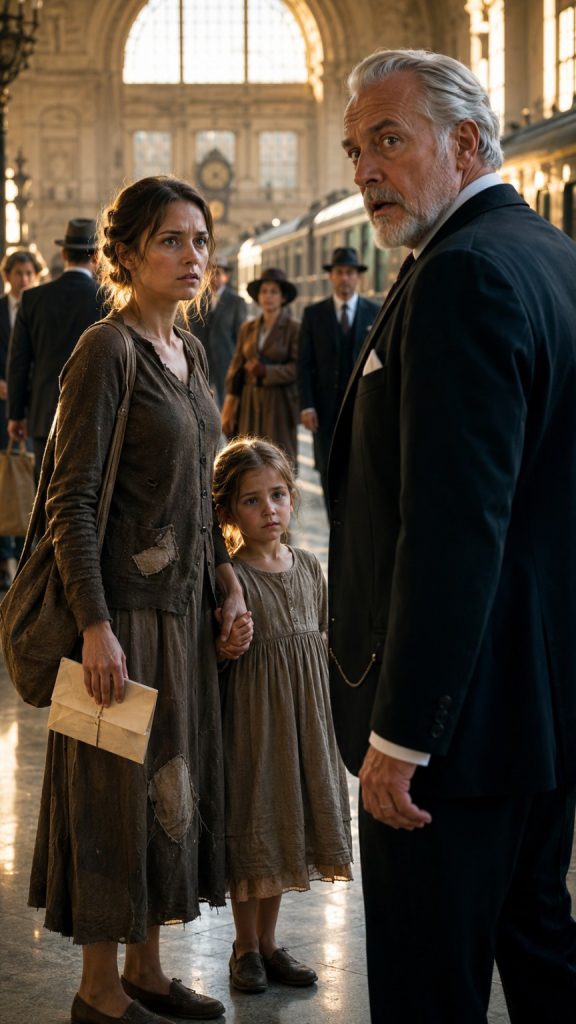
The train station was full of people, but Clara felt as if every sound had disappeared.
The whistle of the arriving train, the footsteps on the marble floor, the murmurs of travelers rushing past her — all of it became distant the moment she saw him.
The man in the black suit.
The silver-haired man standing near the platform with a leather briefcase in his hand.
Edward Whitmore.
For years, that name had lived in Clara’s mind like a locked door. Her husband had spoken it only once, on the night before he disappeared.
“If anything ever happens to me,” he had said, pressing an envelope into her hand, “take this to my father. But only if you have no other choice.”
Clara had no other choice now.
Her little daughter, Lily, stood beside her, holding her hand tightly. The child was only seven, but she had learned how to be quiet around pain. She knew her mother had been worried for days. She knew the envelope was important. She knew the train station meant something.
But she did not know that the man standing only a few steps away was her grandfather.
Clara’s dress was old and patched. Her shoes were worn thin. Lily’s coat was too small at the sleeves. They looked completely out of place among the polished travelers and businessmen moving through the grand station.
Edward Whitmore looked like someone from another world.
He was wealthy, respected, and distant. The kind of man people made room for without being asked. His face carried authority, but there was something tired in his eyes, as if success had not protected him from regret.
Clara took one careful step forward.
Then another.
Edward turned slightly, noticing her only because Lily’s small hand brushed against his sleeve.
At first, he looked annoyed.
Then he saw Clara’s face.
And the envelope in her hand.
His expression changed.
“Can I help you?” he asked.
Clara’s voice almost failed her.
“You don’t remember me,” she said softly, “but you made a promise here.”
Edward stared at her.
The words struck him harder than he expected. For a moment, his eyes moved past Clara, toward the old clock above the platform. Platform Six. The same place. The same golden light through the windows.
A memory stirred.
A young man standing in front of him years ago.
A son he had been too proud to forgive.
Edward’s jaw tightened.
“What promise?” he asked, though his voice was no longer cold.
Clara lifted the envelope.
“My husband left this for you.”
Edward looked at the envelope, then at the little girl beside her.
“Your husband?” he said.
Clara nodded.
“Daniel Whitmore.”
The name changed everything.
Edward’s face lost its color.
For a second, the station seemed to stop around them.
Lily looked up at him, confused by the sudden silence.
Edward took a step back.
“No,” he whispered. “That’s not possible.”
Clara held the envelope closer to her chest.
“He told me you might say that.”
Edward’s eyes moved to Lily.
The child had Daniel’s eyes.
The same soft brown eyes Edward had once seen in his son when he was a boy, running through the halls of the family home before pride and money and anger had broken everything apart.
Edward’s hand trembled slightly.
“What is her name?” he asked.
“Lily.”
The little girl looked up at him.
“My daddy’s name was Daniel,” she said quietly.
Edward closed his eyes.
For eight years, he had told himself Daniel had chosen to disappear. He had told himself his son had walked away from the family, from the business, from everything Edward had built.
But deep down, he had always known the truth was not that simple.
Daniel had not left because he was careless.
He had left because Edward had made him choose.
Family name or love.
Inheritance or Clara.
Power or peace.
Daniel chose Clara.
Edward chose pride.
And after that, the silence between father and son grew so wide that no letter, no apology, no regret could cross it.
Until now.
“Where is Daniel?” Edward asked.
Clara looked down.
Lily’s small fingers tightened around her mother’s hand.
“He is gone,” Clara said.
The words were gentle, but they struck like a stone.
Edward looked away, blinking hard.
“How?” he asked.
“He became sick while working in the north,” Clara said. “He tried to come back before it was too late. He wanted to bring Lily here. He wanted her to meet you.”
Edward’s face twisted with pain.
“He never came.”
“No,” Clara said. “But he left this.”
She handed him the envelope.
Edward stared at it for several seconds before taking it. The paper was old and carefully sealed. His name was written across the front in Daniel’s handwriting.
For a moment, Edward was no longer a powerful man at a train station.
He was only a father holding the last words of his son.
He opened it slowly.
Inside was a letter.
And a small train ticket from years ago.
Edward unfolded the letter.
His son’s words waited there.
Father,
If Clara is standing in front of you, then I am not there to speak for myself. Please do not punish her for loving me. Please do not let my daughter grow up believing she was unwanted by the family she never met.
I know we were both proud. I know we both said things we should not have said. But I waited for you at Platform Six the day I left. I waited because a part of me believed you would come after me.
You didn’t.
Still, I kept the ticket. Not because I hated you, but because I hoped one day we would both return to the place where everything changed.
If you still have any love left for me, give it to my daughter. She deserves more than the silence we left behind.
Daniel
Edward lowered the letter.
The station blurred in front of him.
All the money he had earned, all the respect people gave him, all the rooms full of expensive things — none of it mattered in that moment.
His son had waited for him.
And he had not come.
PAGE BREAK HERE
The Promise He Failed to Keep
Edward looked at Clara, then at Lily.
“I was here that day,” he said quietly.
Clara’s eyes widened.
Edward swallowed.
“I came late. Too late. I stood on this platform after the train had already left. I told myself Daniel made his choice. I told myself he didn’t need me.”
He looked down at the ticket in his hand.
“But the truth is… I was ashamed. I was angry. And I was too proud to admit that I loved my son more than I loved being right.”
Clara said nothing.
There was pain in her face, but not hatred.
That made it harder for Edward.
He had expected accusation. He had expected bitterness. He had expected someone to blame him.
Instead, Clara simply looked tired.
“I didn’t come here for money,” she said. “Daniel made me promise I would bring the letter if Lily ever needed family. I tried to do everything alone. I really did.”
Her voice broke slightly.
“But she deserves to know where she comes from.”
Edward turned toward Lily.
The little girl was watching him carefully, as children do when they can feel grown-up sadness but do not fully understand it.
“Did my daddy love trains?” she asked.
Edward let out a small, broken laugh through his tears.
“Yes,” he said. “He loved them. When he was your age, he used to ask me to bring him here every Sunday. He said trains looked like they were carrying people toward new beginnings.”
Lily looked at the long train beside them.
“Mommy says he wanted to bring me here.”
“He did,” Edward said.
The child studied him.
“Are you my grandpa?”
The question was simple.
Edward had faced boardrooms, lawyers, judges, and powerful men without fear. But this little girl’s question nearly broke him.
He knelt slowly, so he was closer to her height.
“If you will allow me to be,” he said, “yes.”
Lily looked at her mother first.
Clara nodded softly.
Then Lily stepped forward and touched Edward’s sleeve.
“My daddy said family can be late,” she whispered, “but they should still come.”
Edward covered his mouth for a moment.
Daniel had said that.
It was something he used to say as a young man whenever Edward missed dinner, birthdays, or school events because of business. A small sentence. A gentle complaint. A child asking to matter.
Edward had forgotten.
Daniel had not.
The old man bowed his head.
“I am very late,” he said. “But I am here now.”
Clara looked away, wiping her eyes.
Around them, the station continued moving. People boarded trains. Suitcases rolled across the floor. Announcements echoed from above.
But for the three of them, time had narrowed to one platform, one letter, and one chance to repair what pride had destroyed.
Edward stood.
“Clara,” he said carefully, “I know I cannot undo what happened. I cannot bring Daniel back. I cannot erase the years you carried everything alone.”
Clara held her breath.
“But I can make sure you and Lily are never alone again.”
She shook her head slightly.
“I don’t want charity.”
“It is not charity,” Edward said. “It is responsibility. It is family. And it is what my son asked me to do.”
Clara looked at the letter in his hand.
Daniel’s last request had survived longer than his voice.
Edward reached into his briefcase and pulled out a small card.
“This is my personal address,” he said. “Not my office. Not my assistant. Mine.”
Clara hesitated before taking it.
Edward continued, “Come to the house tomorrow. Or next week. Or whenever you are ready. No pressure. No conditions.”
He looked down at Lily.
“And if your mother agrees, I would like to show you your father’s old room one day. His books are still there. His drawings. Even a wooden train he refused to throw away.”
Lily’s eyes brightened for the first time.
“He had toys?”
Edward smiled sadly.
“Many.”
Clara saw the change in her daughter’s face. It was not greed. It was connection. A child reaching toward a father she could no longer hold by discovering the pieces he left behind.
That was why Clara had come.
Not for wealth.
Not for revenge.
For Lily.
“I’ll think about it,” Clara said.
Edward nodded.
“That is more than I deserve.”
For a moment, no one spoke.
Then a train whistle sounded.
Lily turned toward it, startled, then smiled a little.
Edward looked at the ticket again. The old ticket Daniel had kept all those years. The ticket from the day Edward should have run after him.
He folded it carefully and placed it back inside the envelope.
Then he handed the envelope to Lily.
“This belongs to you now,” he said.
Lily held it with both hands.
“Why?”
“Because it is part of your father’s story.”
The little girl looked at the envelope, then back at him.
“Will you tell me the rest?”
Edward’s eyes filled again.
“Yes,” he said. “If your mother allows me, I will tell you everything I remember.”
Clara looked at him for a long moment.
She saw grief in him. Real grief. She saw regret too, but also something else — a man who had spent years building walls and had finally found the one person small enough and innocent enough to walk through them.
Her daughter.
Clara took Lily’s hand again.
“We have to go,” she said gently.
Edward nodded, though it clearly hurt him.
“I understand.”
They began to walk away.
But after only a few steps, Lily stopped and turned back.
“Grandpa?”
Edward froze.
It was the first time she had called him that.
“Yes?”
Lily lifted the envelope slightly.
“If we come tomorrow… can you show me the wooden train?”
Edward’s face softened completely.
“Yes,” he whispered. “I would like that very much.”
Clara did not smile fully, not yet. Trust takes longer than one emotional moment. But something in her expression changed.
A door had opened.
Not all the way.
But enough.
The next afternoon, Clara and Lily arrived at Edward’s home.
Not as beggars.
Not as strangers.
As family.
Edward was waiting at the door with a small wooden train in his hands. It was old, scratched, and carefully polished, as if he had spent the whole night cleaning it.
Lily ran her fingers over it gently.
“This was Daddy’s?”
Edward nodded.
“He loved it.”
Lily hugged it to her chest.
Clara watched Edward turn away slightly, trying to hide his tears.
For the first time, she understood something Daniel had once told her.
“My father is not a cold man,” he had said. “He is a lonely man who forgot how to ask for forgiveness.”
That day, in the quiet entrance of the Whitmore house, Edward finally asked.
“I am sorry,” he said to Clara. “For the years. For the silence. For not coming sooner.”
Clara held Lily close.
“I can’t forgive everything in one day,” she said honestly.
Edward nodded.
“I know.”
“But we can begin,” she added.
And that was enough.
Weeks later, Lily started visiting every Sunday.
Edward told her stories about Daniel — how he laughed, how he loved trains, how he once tried to build a railway across the family garden with sticks and string. Clara listened too, collecting pieces of the man she loved from the father who had finally learned to speak of him with tenderness.
The old envelope was placed in a frame beside Daniel’s photograph.
Not as a symbol of sadness.
But as proof that one message, carried by the right hands, can cross years of silence.
And sometimes, the person waiting at the station is not there to say goodbye.
Sometimes, they are there because a story that seemed finished is finally ready to begin again.
Final Note
This is a fictional AI-created story made for entertainment purposes. The characters, names, places, and events are imaginary. Any resemblance to real people or real events is purely coincidental.