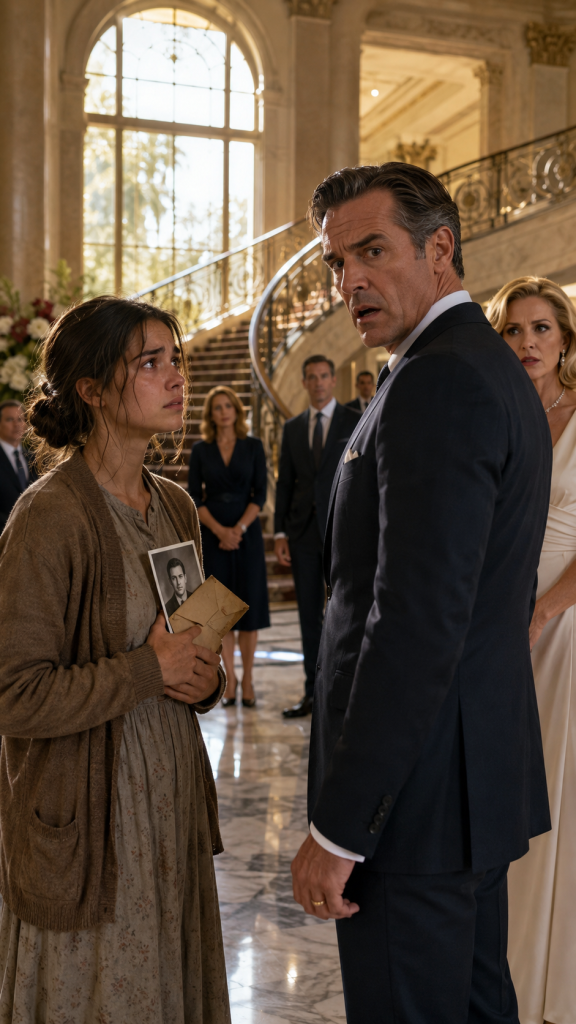
The grand lobby went silent the moment the young woman stepped inside.
She did not belong there.
At least, that was what everyone thought.
The marble floor beneath her shoes was polished enough to reflect the golden light pouring through the tall windows. Crystal chandeliers hung above her. Elegant guests stood near the staircase holding glasses, wearing expensive dresses and tailored suits, whispering as if the air itself belonged to them.
And in the middle of that luxury stood a young woman in an old brown cardigan, clutching a sealed envelope and a black-and-white photograph against her chest.
Her name was Emma.
She had walked for almost an hour to reach the Whitmore estate. Her shoes were damp. Her hands were cold. Her face was pale, but her eyes were steady.
She had not come for money.
She had not come to embarrass anyone.
She had come because her mother’s last words had sent her there.
“If life becomes too heavy,” her mother had whispered, placing the photo and envelope in Emma’s hands, “go to the Whitmore mansion. Ask for Jonathan Whitmore. And no matter what anyone says, do not leave until he sees the picture.”
For three weeks after her mother passed away, Emma kept the envelope hidden under her mattress.
She was afraid to open it.
Afraid of what it might reveal.
Afraid it might prove what she had suspected all her life — that her mother had carried a secret too painful to speak aloud.
But that morning, after receiving a final notice from her landlord and realizing she had nowhere else to go, Emma took the envelope, the photograph, and the courage she had left.
Now she stood inside a house that looked like a palace, surrounded by people who stared at her as if she were a mistake.
“Excuse me,” a woman in a white dress said from the staircase. Her tone was polite, but her face was not. “Who let you in?”
Emma turned.
The woman was elegant, blonde, and perfectly composed. A diamond necklace rested against her collarbone. She looked like she had never had to knock twice on any door in her life.
“I’m sorry,” Emma said softly. “I need to speak to Mr. Jonathan Whitmore.”
The room shifted.
People looked toward the man standing near the center of the lobby.
Jonathan Whitmore turned slowly.
He was tall, sharply dressed in a dark suit, with the kind of presence that made people quiet before he even spoke. His expression was controlled at first, almost irritated.
Then he saw the photograph in Emma’s hands.
His face changed.
Not completely.
Not enough for the guests to understand.
But enough for Emma to notice.
“Who are you?” he asked.
Emma swallowed.
“My mother told me to bring this here,” she said. “She said you would know what it means.”
Jonathan stepped closer.
His wife, Caroline, moved behind him, her eyes narrowing.
“What is this?” Caroline asked.
Emma held out the photograph.
Jonathan took it.
For a few seconds, he simply stared.
The photo showed two young men standing beside a garden fountain many years earlier. One was Jonathan, much younger. The other man looked almost exactly like him, but with a softer face and a wider smile.
Beside them stood a young woman in a simple dress.
Emma’s mother.
Jonathan’s hand tightened around the photo.
“Where did you get this?” he asked.
“It belonged to my mother,” Emma said.
“What was her name?”
“Clara Bennett.”
The name struck him like a sound from a locked room.
Behind him, Caroline’s expression shifted from confusion to concern.
Jonathan looked at Emma more carefully now.
The eyes.
The shape of her face.
The way she held her chin when she was trying not to cry.
He had seen that look before.
Not in Clara.
In his brother.
“Why did your mother send you to me?” Jonathan asked quietly.
Emma looked down at the sealed envelope.
“She said the truth was inside.”
A few guests began whispering. Someone near the staircase gasped softly.
Caroline stepped forward.
“Jonathan, maybe this should be handled privately.”
But Jonathan did not move.
His eyes were fixed on the envelope.
Across the front, written in old ink, was his name.
Jonathan Whitmore
And beneath it, in smaller writing:
If she ever comes, please do not turn her away.
Jonathan’s face went pale.
Because he recognized the handwriting.
His brother’s handwriting.
Thomas Whitmore had disappeared twenty-three years ago.
The family had said he left because he was reckless. Because he was weak. Because he wanted a life beneath the Whitmore name.
Jonathan had believed that version for years because it was easier than believing something else.
Something worse.
That the family had pushed him out.
That pride had become stronger than love.
That Thomas had tried to come back, and no one had opened the door.
Jonathan looked at Emma.
“How old are you?” he asked.
“Twenty-two.”
The answer made the silence heavier.
Caroline covered her mouth.
Jonathan opened the envelope with shaking hands.
Inside was a letter.
The lobby disappeared around him.
There was only the paper, the handwriting, and the voice of a brother he had spent half his life pretending not to miss.
Jonathan,
If this letter reaches you, then Clara has finally done what I was too afraid to ask of her. The girl standing before you is my daughter. Her name is Emma. She is innocent of every mistake I made and every argument our family ever had.
I left because Father gave me a choice: the family name or the woman I loved. I chose Clara. I never regretted that. But I regretted leaving you without saying goodbye.
I tried to return once. I stood outside the gate with Clara beside me, but I was told no one wanted to see us. Maybe that was true. Maybe it was not. I never knew.
If you still remember me as your brother, then please remember my daughter too. She does not need your fortune. She needs to know she was not born from shame. She was born from love.
Thomas
Jonathan lowered the letter.
His breath caught in his chest.
For years, he had heard rumors. Stories. Family explanations designed to protect reputations.
But no one had told him Thomas came back.
No one had told him there was a child.
No one had told him his brother had died believing the door was closed.
Emma stood frozen, searching his face for an answer.
“So it’s true?” she whispered. “He was my father?”
Jonathan looked at her.
The question was so simple that it nearly broke him.
“Yes,” he said, voice unsteady. “Thomas was your father.”
Emma pressed one hand over her mouth.
She had imagined this moment many times. She had imagined anger. Rejection. Coldness. A guard leading her out. A rich man laughing at a poor girl with an old photograph.
She had not imagined grief.
Jonathan’s eyes filled with it.
Caroline looked from the letter to Emma, then to the guests watching behind them.
“Jonathan,” she said softly, “everyone is staring.”
He did not care.
For the first time in years, the perfect image of the Whitmore family did not matter to him.
Only the young woman standing in front of him mattered.
His brother’s daughter.
The niece he never knew existed.
The Secret Behind the Photograph
Jonathan led Emma into the private library while the guests remained outside in stunned silence.
Caroline followed them, closing the doors gently behind her.
The library was quiet, warm, and lined with shelves of old books. A fire burned low in the stone fireplace. On the wall hung several family portraits, each one polished, proud, and silent.
Emma stood near the door, still holding the photograph.
She looked uncomfortable, as if even the carpet beneath her feet was too expensive for her to touch.
Jonathan noticed.
“Please sit,” he said.
Emma did not.
“I don’t want anything from you,” she said quickly. “My mother told me to come here only if I needed the truth. That’s all I came for.”
Jonathan looked down.
“That is exactly what Thomas would have wanted you to say.”
The words made Emma’s eyes fill again.
“You knew him well?”
Jonathan gave a sad smile.
“He was my younger brother. I thought I knew him better than anyone. Then one day, I let other people tell me who he was.”
Caroline stood near the fireplace, her expression softer now.
“What happened to him?” she asked.
Emma looked at the letter.
“My mother said he worked hard after they left. He wanted to build a life for us. But he became sick before I was born. She said he passed away holding the same photograph.”
Jonathan closed his eyes.
He remembered Thomas laughing in the gardens. Thomas playing piano badly but joyfully. Thomas arguing at the dinner table because he believed love mattered more than status.
And he remembered doing nothing when their father called Thomas a disgrace.
That was the memory that hurt most.
Not what Thomas did.
What Jonathan failed to do.
“There is something you should know,” Jonathan said.
He walked to an old desk and unlocked a lower drawer. From inside, he took a small wooden box.
“I kept this hidden for years.”
He opened it.
Inside were letters.
Dozens of them.
Emma stepped closer.
Jonathan lifted one carefully.
“They were from Thomas,” he said. “Most never reached me until after our father died. I found them in his study. He had kept them from me.”
Emma’s face changed.
“He wrote to you?”
“Many times.”
Jonathan handed her one letter.
Emma unfolded it with trembling fingers.
Jonathan,
I know Father told you I left without looking back. That is not true. I miss you. I miss the house sometimes too, though I do not miss what it did to us. Clara is expecting a child. If it is a girl, I think we will name her Emma. I hope one day you will meet her. I hope she will know at least one Whitmore who can love without conditions.
— Thomas
Emma’s tears fell onto the paper.
“He chose my name,” she whispered.
Jonathan nodded.
“Yes.”
For the first time since entering the mansion, Emma sat down.
The weight of what she had carried became too much.
All her life, she had known only pieces. A mother who worked too hard. A father spoken of gently but rarely. A silver-framed photograph hidden in a drawer. A sealed envelope no one was allowed to open until there was no other choice.
Now the pieces were forming a story.
Not an easy one.
But a real one.
Caroline sat beside her.
“I’m sorry,” she said quietly.
Emma looked at her, surprised.
Caroline continued, “I judged you when you walked in. I thought you were here to cause trouble. I was wrong.”
Emma wiped her face.
“I probably looked like trouble.”
“No,” Caroline said. “You looked like someone who had nowhere else to go but still had the courage to come.”
Jonathan looked at his wife gratefully.
Then he turned back to Emma.
“Your father belonged here,” he said. “And because of him, so do you.”
Emma shook her head.
“I don’t know this family.”
“Then we will not rush you,” Jonathan said. “You do not have to trust us today. You do not have to forgive what happened before you were born. But you should not walk out of this house believing you are alone.”
Emma held the photograph close to her chest.
“My mother worked her whole life,” she said. “She never asked anyone for help. She made me promise I wouldn’t become bitter.”
Jonathan smiled sadly.
“Clara sounds stronger than all of us.”
“She was.”
The room became quiet.
Then Jonathan stood and walked to the wall of portraits. He looked at one empty space near the end of the line.
“That space was supposed to hold Thomas’s portrait,” he said. “Father removed it after he left.”
Emma looked at the empty place.
Jonathan turned to her.
“If you allow it, I would like to place this photograph there.”
Emma’s lips parted slightly.
“My mother is in it too.”
“I know.”
“And you still want it there?”
Jonathan nodded.
“Especially because she is in it.”
For the first time, Emma’s expression changed.
A small, fragile smile touched her face.
Not happiness exactly.
Something closer to relief.
Later that evening, after the guests had left and the mansion had grown quiet, Jonathan asked Emma if she would stay for dinner.
She almost refused.
Then Caroline said, “Only if you want to. No pressure.”
That made Emma stay.
At the table, Jonathan told her stories about Thomas. Not perfect stories. Real ones. How he used to sneak out to listen to street musicians. How he once gave away his expensive coat to a stranger in winter. How he hated formal dinners and loved simple bread with butter more than any chef’s dish.
Emma listened as if gathering pieces of someone she had always missed without knowing him.
Before she left, Jonathan placed the wooden box of letters in her hands.
“These belong to you,” he said.
Emma looked at the box.
“I can’t take them all.”
“Yes, you can. They are your father’s voice.”
She held the box tightly.
At the door, she turned back.
“Why did my mother wait so long to send me here?”
Jonathan looked toward the photograph now resting temporarily on the library desk.
“Maybe she was protecting you,” he said. “Maybe she was protecting herself. Or maybe she hoped we would become worthy before you arrived.”
Emma thought about that.
Then she said softly, “Are you?”
Jonathan’s eyes filled again.
“I don’t know,” he admitted. “But I would like the chance to try.”
A week later, Emma returned.
This time, she did not stand in the lobby like a stranger.
Jonathan met her at the door himself.
In the library, the empty space on the wall was no longer empty. The old black-and-white photograph had been framed in gold and placed among the family portraits.
Thomas stood there smiling.
Clara stood beside him.
And between the past and the present, Emma finally saw what her mother had wanted her to understand.
She had not come from shame.
She had come from love.
Jonathan stood beside her quietly.
“Welcome home,” he said.
Emma looked at the photograph, then at the uncle she had only just found.
For the first time in many years, the word home did not feel like something meant for other people.
It felt possible.
And sometimes, that is how a family begins again — not with a perfect past, but with one brave person carrying the truth through the front door.
Final Note
This is a fictional AI-created story made for entertainment purposes. The characters, names, places, and events in this story are imaginary. Any resemblance to real people, real families, real businesses, or real events is purely coincidental.