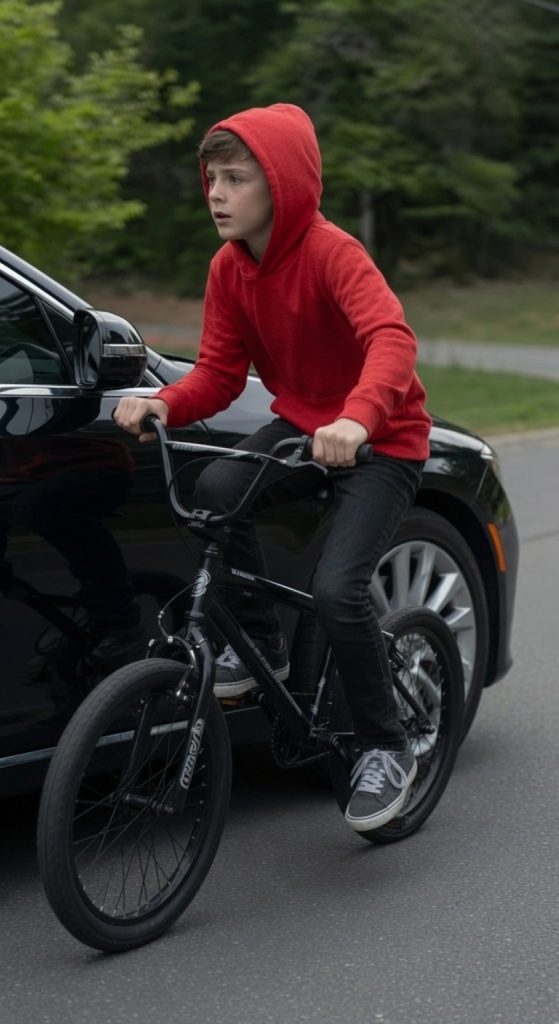
The road was quiet that afternoon.
Tall trees leaned over both sides, their leaves moving softly in the wind. The pavement was still damp from a short morning rain, and the black surface reflected the pale daylight like a mirror. Only a few cars passed now and then, their tires making a low whisper against the wet road.
Jason Carter rode his old black bicycle close to the side of the lane.
He was eighteen, but life had made him look younger and older at the same time. His red hoodie was faded at the sleeves. His sneakers were worn. A small backpack rested against his shoulders, heavy with notebooks, a work shirt, and a lunch he had not had time to eat.
He was not riding for fun.
He was riding because the bus had stopped running near his neighborhood, and he could not afford to be late again.
Jason had two jobs, evening classes, and one promise he repeated to himself every morning:
Keep going.
No matter how tired he was.
No matter how many people looked through him like he was part of the road.
That day, he was on his way to a small repair shop where he worked after school. His boss had warned him the week before that another late arrival would cost him the job. Jason needed that money. His mother’s medicine was expensive, and his younger sister needed school supplies before the end of the month.
So he pedaled faster.
The road narrowed near a curve.
That was when the black luxury car appeared beside him.
At first, Jason thought the driver would pass.
Instead, the car slowed down next to him, too close to the bike. The windows were dark, the paint polished, the engine low and smooth. It looked like the kind of car that belonged to someone who never worried about being late, hungry, or ignored.
Jason kept his eyes forward.
The car drifted closer.
His handlebars shook slightly.
“Hey!” Jason shouted. “Careful!”
The car did not move away.
A second later, its side brushed the front wheel of the bicycle.
It was not a hard crash, but it was enough.
The bike twisted.
Jason lost balance.
The world tilted.
His shoulder hit the road first, then his knees. The bike scraped against the pavement and slid a short distance ahead of him. For a moment, all Jason heard was the spinning of the rear wheel and the fast beating of his own heart.
The black car stopped.
Jason pushed himself up quickly, breathing hard. His palms stung from the fall, but there was no blood. No serious injury. Just shock, anger, and the burning feeling of being treated like he did not matter.
The driver’s window lowered.
A man in sunglasses leaned out.
He was well-dressed, clean-shaven, and smiling in the way some people smile when they know no one usually challenges them.
“Watch where you’re going,” the driver said.
Jason stared at him.
“You hit me.”
The man gave a short laugh.
“I barely touched you.”
“You pushed me off the road.”
The driver looked at Jason’s old bike, then at his worn hoodie.
“Then maybe ride somewhere else.”
Jason stood fully now. His bicycle lay on its side beside him. One pedal was bent. The front wheel looked crooked.
“I need your insurance information,” Jason said.
The driver laughed again, louder this time.
“Insurance? For that old thing?”
Jason took one step closer, still calm but shaking with frustration.
“You damaged my bike. I need it for work.”
The man leaned farther out of the window.
“Work?” he said. “You look like you should be in class.”
Jason’s jaw tightened.
“I’m eighteen.”
The driver looked amused.
“Then act like it. Move your bike before you block the road.”
Jason did not move.
The man’s smile faded.
“What do you want?” he asked. “You want to call your father?”
The words were meant to embarrass him.
The driver clearly expected Jason to lower his head, pick up the broken bike, and disappear.
For a second, Jason said nothing.
Then he reached into his pocket and took out his phone.
The driver chuckled.
“Oh, you’re really calling him?”
Jason looked at him.
“Yes.”
The man shook his head, still smiling.
“This should be good.”
Jason lifted the phone to his ear.
The call rang twice.
Then a deep voice answered.
Jason’s voice stayed calm.
“Dad,” he said. “I’m on Pine Road, near the old bridge. I need you to come now.”
The driver’s smile did not disappear right away.
He looked almost entertained.
But something about Jason’s calmness made the air feel different.
There was no shouting. No panic. No begging.
Just one quiet phone call.
“Is that supposed to scare me?” the driver asked.
Jason lowered the phone.
“No,” he said. “It’s supposed to end this.”
For the first time, the driver looked uncertain.
A minute passed.
Then another.
The road remained quiet.
The driver looked at his watch, irritated.
“I don’t have time for this.”
Jason bent down and lifted his bicycle carefully. The front wheel wobbled. He set it beside him and waited.
The driver was about to close his window when a sound came from behind them.
Engines.
Not one.
Several.
Jason looked toward the curve in the road.
The driver looked too.
The first black SUV appeared slowly around the bend.
Then another.
Then a third.
They moved with calm precision, not rushing wildly, not making noise for attention. But there was something serious about them. The kind of seriousness that made people stop speaking.
The SUVs pulled up behind the black luxury car and stopped in a neat line.
Doors opened.
Several men in dark suits stepped out first. Behind them came an older man in a charcoal coat, walking with purpose.
Jason’s father.
Michael Carter.
He was not the kind of man people expected when they heard “Dad” from a young man in a torn red hoodie.
Michael Carter was the founder of Carter Protection Group, a private safety and transport company known for protecting executives, witnesses, and families in high-risk situations. He had spent his life building a reputation for discipline, calm decisions, and quiet power.
But to Jason, he was simply Dad.
The man who taught him how to fix a bike chain.
The man who stayed up during his mother’s hospital nights.
The man who told him that dignity mattered most when someone tried to take it from you.
Michael stepped toward Jason first.
“Are you hurt?” he asked.
Jason shook his head.
“I’m okay. The bike isn’t.”
Michael looked down at the bent wheel, then at the driver in the luxury car.
The driver had gone very still.
His sunglasses were still on, but his confidence was no longer there.
Michael turned toward him.
“Did you hit my son?”
The driver swallowed.
“It was an accident.”
Jason looked at him.
“You laughed.”
The silence after that was sharper than any argument.
Michael did not raise his voice.
“Step out of the car, please.”
The driver hesitated.
One of the suited men moved closer, not threatening, just present.
The driver opened the door and stepped out.
His face had changed completely. The arrogance was gone. Now he looked like a man trying to understand how one old bicycle had brought three black SUVs to a quiet road.
The Man Behind the Wheel
Michael looked at the driver carefully.
“What is your name?”
The man adjusted his jacket.
“Richard Vale.”
One of Michael’s assistants looked up quickly at the name.
Michael noticed.
“You know him?” he asked.
The assistant nodded.
“Vale Development. They’re bidding on the city transport contract.”
Jason looked from the assistant to the driver.
The name meant nothing to him, but it clearly meant something to his father.
Michael’s expression hardened slightly.
“Mr. Vale,” he said, “you are bidding for a public transport contract while pushing a cyclist off the road and mocking him for needing his bicycle?”
Richard’s face went pale.
“I said it was an accident.”
Michael looked at Jason.
“Was it?”
Jason took a breath.
“The car came too close. I warned him. He didn’t move away. When I fell, he told me to get out of the road.”
Richard shook his head quickly.
“That’s not exactly—”
Michael raised one hand.
“Careful,” he said quietly. “There may be dash cameras.”
Richard stopped speaking.
That one sentence changed everything.
There were cameras on Michael’s vehicles. Cameras on the SUVs. Possibly cameras on the street. Maybe even cameras in Richard’s own car.
Suddenly, the truth mattered.
Jason watched the driver’s face shift again.
It was not fear of Jason.
It was fear of being seen clearly.
Michael turned to one of his men.
“Call roadside assistance for the bike. Have it repaired today. If it can’t be repaired, replace it.”
Jason shook his head.
“Dad, it’s okay.”
Michael looked at him.
“No, it isn’t.”
The words were calm, but they carried years of meaning.
Jason had heard them before.
When his mother’s insurance delayed medicine.
When his sister’s school ignored bullying.
When Jason took less than he deserved because he did not want to cause trouble.
No, it isn’t.
Sometimes the smallest injustice was not small at all.
Richard looked embarrassed now.
“I can pay for the bike,” he said.
Michael turned back to him.
“You will.”
Richard nodded quickly.
“And you will apologize to my son,” Michael added.
Richard looked at Jason.
The apology seemed to get stuck in his throat.
Jason waited.
Finally, Richard said, “I’m sorry.”
Jason held his gaze.
“For what?”
Richard blinked.
“For hitting your bike.”
Jason said nothing.
Richard swallowed.
“And for laughing.”
Michael watched silently.
Jason nodded once.
Not because everything was fixed.
Because at least the truth had been named.
One of the SUVs’ doors opened, and a woman in a navy suit stepped out with a tablet. She walked to Michael and handed him a file.
“Mr. Carter,” she said, “we were reviewing Vale Development this morning.”
Richard’s face tightened.
Michael looked at the file.
Jason watched his father’s eyes move across the page.
Then Michael looked up.
“Mr. Vale, your company’s proposal mentions safer road access for students and workers.”
Richard said nothing.
Michael continued, “My son is both. A student and a worker. And today, you treated him like an obstacle.”
The road was silent except for the distant sound of leaves moving in the wind.
Richard looked smaller now.
Not because anyone had shouted.
Because his own actions had finally caught up with his public image.
Michael handed the file back.
“I will be speaking at the review meeting tomorrow,” he said. “And I will be honest.”
Richard’s mouth opened slightly.
“You would risk a contract over a bike?”
Michael stepped closer.
“No,” he said. “You risked it when you decided the person on the bike did not matter.”
Jason looked at his father.
He had expected anger.
Maybe a lecture.
Maybe an order to come home.
But this was different.
His father was not saving him by making everyone afraid.
He was showing him how power should be used.
Not to crush someone.
To protect the truth.
Richard looked at Jason again.
This time, there was no mockery in his eyes.
Only shame.
“I didn’t know who you were,” he said quietly.
Jason almost laughed, but not because it was funny.
“That’s the problem,” he said. “You shouldn’t have needed to know.”
The words landed harder than anything his father had said.
Michael looked at Jason with quiet pride.
For a moment, the eighteen-year-old in the red hoodie did not feel small beside the black car, the expensive suits, and the polished SUVs.
He felt seen.
A repair truck arrived twenty minutes later.
The mechanic examined the bike and said the front wheel, pedal, and fork needed work. Jason listened carefully. It was more damage than he expected.
Richard paid without arguing.
Before leaving, Michael asked Jason if he wanted a ride.
Jason looked at his bike.
Then at the road ahead.
“I still have work,” he said.
Michael nodded.
“I’ll have one of the drivers take you.”
Jason hesitated.
“I don’t want special treatment.”
Michael placed a hand on his shoulder.
“Getting safely to work after someone damaged your bike is not special treatment. It is basic respect.”
Jason accepted.
The next day, the video from the roadside camera was reviewed during the transport contract meeting.
Not publicly.
Not loudly.
But carefully.
Richard Vale was forced to explain why his conduct on a quiet road did not match the values written in his company’s proposal. For the first time, the people in the room saw the difference between words prepared for business and character shown when no one important seemed to be watching.
Vale Development did not win the contract.
But the story did not end there.
Two weeks later, Jason received a letter at home.
It was from Richard.
There was no excuse inside.
Only an apology, a receipt showing a donation to a local youth cycling safety program, and one sentence written by hand:
You were right. I should not have needed to know who you were to treat you like you mattered.
Jason read it twice.
Then he handed it to his father.
Michael smiled faintly.
“Sometimes people learn,” he said.
Jason looked toward the garage, where his repaired bike leaned against the wall, cleaner than it had been in years.
“Do you think he really did?”
Michael folded the letter.
“I don’t know. But you gave him the chance to.”
That evening, Jason rode his bike again.
The road looked the same.
Same trees.
Same curve.
Same damp pavement after another light rain.
But something inside him had changed.
He still had work.
He still had bills.
He still had responsibilities too heavy for someone his age.
But he also had proof of something his father had always tried to teach him:
Dignity is not something rich people give to you.
It is something no one has the right to take away.
As Jason pedaled toward town, he passed the old bridge and smiled for the first time all day.
Behind him, the road was quiet again.
But he would never forget the moment a man in a luxury car asked if he was going to call his father.
And Jason did.
Not because he was weak.
Because sometimes the strongest thing a person can do is ask the right person to stand beside them while the truth arrives.
Final Note
This is a fictional AI-created story made for entertainment purposes. The characters, names, businesses, places, and events in this story are imaginary. Any resemblance to real people, real companies, real organizations, or real events is purely coincidental.